Every matrix in the suite was factored by sTiles and five reference sparse direct solvers. For each matrix and solver we report the best factorization time over a sweep of thread counts. Times below are the same measurements reported in the paper.
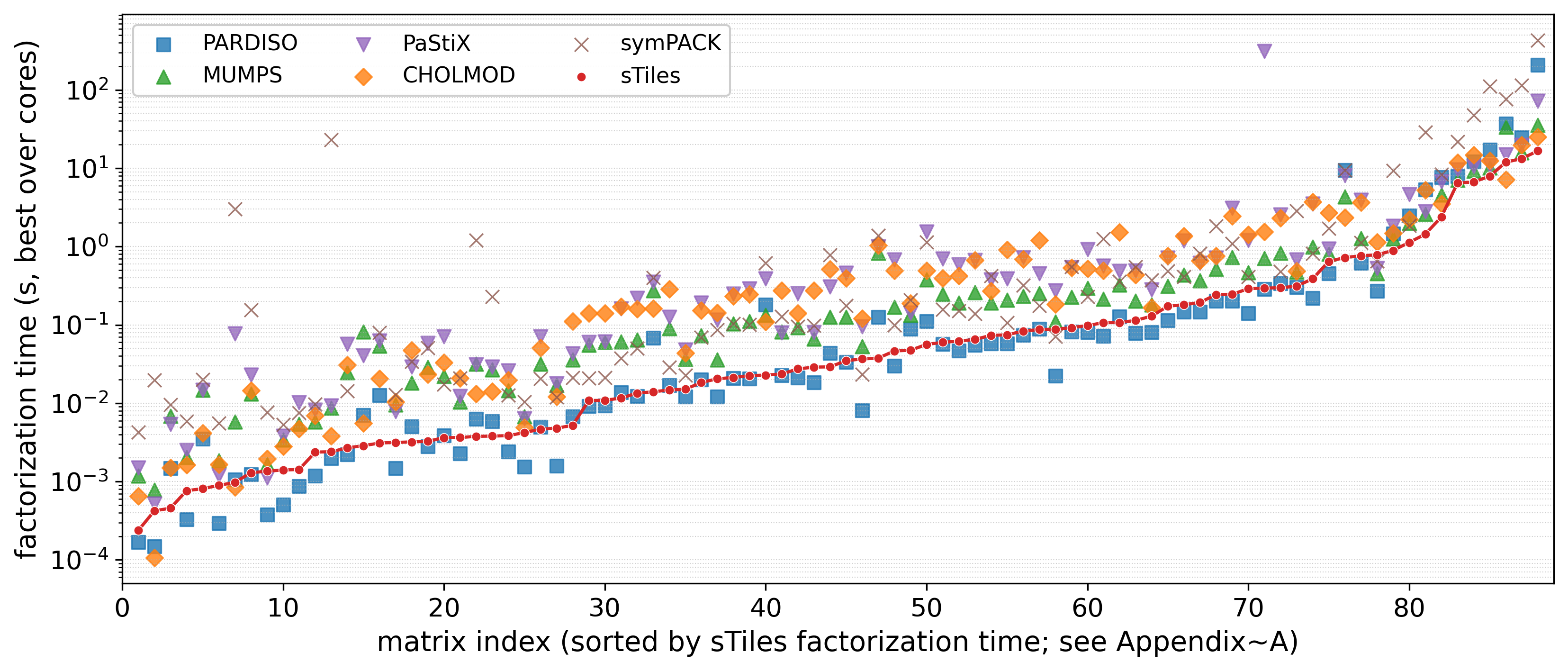
Best factorization time (minimum over the swept core counts) for every matrix in the 60-matrix suite and every solver, on the Intel node. Matrices are sorted along the horizontal axis by sTiles' time, so the sTiles curve is monotonic; a competitor marker below it is faster than sTiles on that matrix, above it slower. PARDISO is the closest solver: it is faster than sTiles on 15 matrices, all below 0.5 s; sTiles is faster on the other 45, including all 12 above 0.5 s. MUMPS, PaStiX, CHOLMOD, and symPACK are slower than sTiles on 97 to 100% of the matrices each of them factors.
| # | matrix | sTiles | PARDISO | MUMPS | CHOLMOD | PaStiX | symPACK |
|---|---|---|---|---|---|---|---|
| 1 | inla_graph_sem_n2000 | 0.0005 | 0.0015 | 0.0069 | 0.0015 | 0.0054 | 0.0095 |
| 2 | inla_graph_sem_n5000 | 0.0008 | 0.0035 | 0.015 | 0.0041 | 0.015 | 0.020 |
| 3 | inla_graph_8rtKSK | 0.0010 | 0.0011 | 0.0058 | 0.0009 | 0.078 | 3.00 |
| 4 | nasa4704 | 0.0013 | 0.0012 | 0.0058 | 0.0069 | 0.0082 | 0.0097 |
| 5 | gyro_m | 0.0013 | 0.0013 | 0.013 | 0.015 | 0.023 | 0.154 |
| 6 | bcsstk15 | 0.0016 | 0.0015 | 0.0096 | 0.010 | 0.0078 | 0.013 |
| 7 | gyro_k | 0.0018 | 0.0023 | 0.025 | 0.031 | 0.057 | 0.014 |
| 8 | inla_graph_sh7Pgi | 0.0026 | 0.0019 | 0.0086 | 0.0038 | 0.0093 | 23.0 |
| 9 | inla_graph_pedigree | 0.0029 | 0.0070 | 0.082 | 0.0056 | 0.041 | — |
| 10 | inla_graph_sem_n20000 | 0.0031 | 0.013 | 0.054 | 0.021 | 0.063 | 0.080 |
| 11 | inla_graph_diff | 0.0032 | 0.0051 | 0.018 | 0.048 | 0.029 | 0.034 |
| 12 | msc10848 | 0.0036 | 0.0039 | 0.022 | 0.033 | 0.071 | 0.017 |
| 13 | inla_graph_net814381 | 0.0038 | 0.0063 | 0.032 | 0.013 | 0.031 | 1.21 |
| 14 | inla_graph_ayaLRw | 0.0038 | 0.0059 | 0.027 | 0.014 | 0.029 | 0.228 |
| 15 | msc23052 | 0.0047 | 0.0050 | 0.032 | 0.051 | 0.072 | 0.021 |
| 16 | thermal1 | 0.0052 | 0.0068 | 0.036 | 0.111 | 0.043 | 0.021 |
| 17 | inla_graph_lgm_10010_bw2 | 0.010 | 0.013 | 0.036 | 0.044 | 0.048 | 0.023 |
| 18 | nasasrb | 0.012 | 0.014 | 0.061 | 0.172 | 0.163 | 0.037 |
| 19 | oilpan | 0.013 | 0.012 | 0.065 | 0.160 | 0.219 | 0.050 |
| 20 | inla_graph_sem_n100000 | 0.014 | 0.068 | 0.276 | 0.162 | 0.353 | 0.400 |
| 21 | thermomech_dM | 0.015 | 0.017 | 0.090 | 0.287 | 0.125 | 0.029 |
| 22 | ct20stif | 0.018 | 0.020 | 0.073 | 0.152 | 0.191 | 0.069 |
| 23 | s3dkt3m2 | 0.019 | 0.021 | 0.104 | 0.231 | 0.248 | 0.103 |
| 24 | smt | 0.021 | 0.022 | 0.092 | 0.140 | 0.253 | 0.095 |
| 25 | inla_graph_ferris | 0.021 | 0.013 | 0.036 | 0.143 | 0.116 | 0.087 |
| 26 | s3dkq4m2 | 0.022 | 0.021 | 0.111 | 0.247 | 0.291 | 0.101 |
| 27 | inla_graph_animal1 | 0.023 | 0.181 | 0.133 | 0.110 | 0.391 | 0.613 |
| 28 | apache1 | 0.024 | 0.023 | 0.081 | 0.273 | 0.079 | 0.127 |
| 29 | inla_graph_bern_spd | 0.029 | 0.044 | 0.126 | 0.511 | 0.306 | 0.775 |
| 30 | bmw7st_1 | 0.030 | 0.033 | 0.126 | 0.394 | 0.460 | 0.175 |
| 31 | inla_graph_83o4NNNo | 0.031 | 0.0082 | 0.053 | 0.120 | 0.096 | 0.023 |
| 32 | inla_graph_stcov | 0.038 | 0.126 | 0.827 | 1.03 | 1.000 | 1.39 |
| 33 | inla_graph_spacetime | 0.047 | 0.089 | 0.133 | 0.188 | 0.143 | 0.208 |
| 34 | nd3k | 0.051 | 0.081 | 0.181 | 0.165 | 0.281 | 0.375 |
| 35 | pwtk | 0.052 | 0.055 | 0.260 | 0.672 | 0.673 | 0.139 |
| 36 | inla_graph_lidense | 0.056 | 0.111 | 0.377 | 0.496 | 1.55 | 1.15 |
| 37 | crankseg_1 | 0.062 | 0.057 | 0.247 | 0.395 | 0.695 | 0.158 |
| 38 | bmw3_2 | 0.074 | 0.070 | 0.232 | 0.685 | 0.732 | 0.320 |
| 39 | boneS01 | 0.084 | 0.083 | 0.227 | 0.533 | 0.546 | 0.552 |
| 40 | crankseg_2 | 0.086 | 0.081 | 0.295 | 0.524 | 0.921 | 0.230 |
| 41 | tmt_sym | 0.087 | 0.089 | 0.254 | 1.20 | 0.453 | 0.176 |
| 42 | ecology2 | 0.107 | 0.128 | 0.326 | 1.53 | 0.485 | 0.359 |
| 43 | af_shell3 | 0.160 | 0.152 | 0.432 | 1.37 | 1.19 | 0.409 |
| 44 | consph | 0.188 | 0.206 | 0.512 | 0.760 | 0.719 | 1.81 |
| 45 | nd6k | 0.208 | 0.312 | 0.475 | 0.486 | 0.679 | 2.86 |
| 46 | inline_1 | 0.297 | 0.340 | 0.826 | 2.31 | 2.54 | 0.481 |
| 47 | inla_graph_yU0G1u | 0.298 | 0.284 | 0.712 | 1.55 | 311 | — |
| 48 | inla_graph_net1628760 | 0.362 | 0.229 | 0.985 | 3.70 | 3.52 | 0.819 |
| 49 | boneS10 | 0.608 | 0.629 | 1.27 | 3.69 | 3.92 | 1.13 |
| 50 | inla_graph_lgm_48600_bw2 | 0.723 | 9.43 | 4.34 | 2.36 | 8.10 | 9.45 |
| 51 | nd12k | 0.891 | 1.47 | 1.25 | 1.48 | 1.83 | 9.27 |
| 52 | inla_graph_lgm_100200_bw1 | 1.13 | 2.48 | 1.98 | 2.22 | 4.65 | 1.85 |
| 53 | inla_graph_lgm_50000_bw15000 | 1.44 | 5.32 | 2.59 | 5.30 | 2.81 | 28.9 |
| 54 | inla_graph_lgm_100200_bw2 | 2.38 | 7.63 | 4.58 | 3.54 | 6.73 | 8.34 |
| 55 | bone010 | 6.44 | 7.88 | 7.03 | 11.8 | 9.56 | 21.8 |
| 56 | audikw_1 | 6.67 | 12.2 | 9.18 | 14.7 | 10.5 | 47.3 |
| 57 | Fault_639 | 7.88 | 17.1 | 10.1 | 12.4 | 10.9 | 110 |
| 58 | inla_graph_lgm_50400_bw2 | 11.9 | 37.1 | 33.5 | 7.16 | 14.9 | 76.7 |
| 59 | Emilia_923 | 13.3 | 24.8 | 15.7 | 19.9 | 19.8 | 115 |
| 60 | inla_graph_animal2 | 16.6 | 209 | 35.7 | 25.0 | 72.1 | 432 |
Best factorization time in seconds on the Intel node (minimum over the swept core counts) for every matrix and solver, sorted by sTiles' time to match the figure above. The fastest solver on each matrix is highlighted.
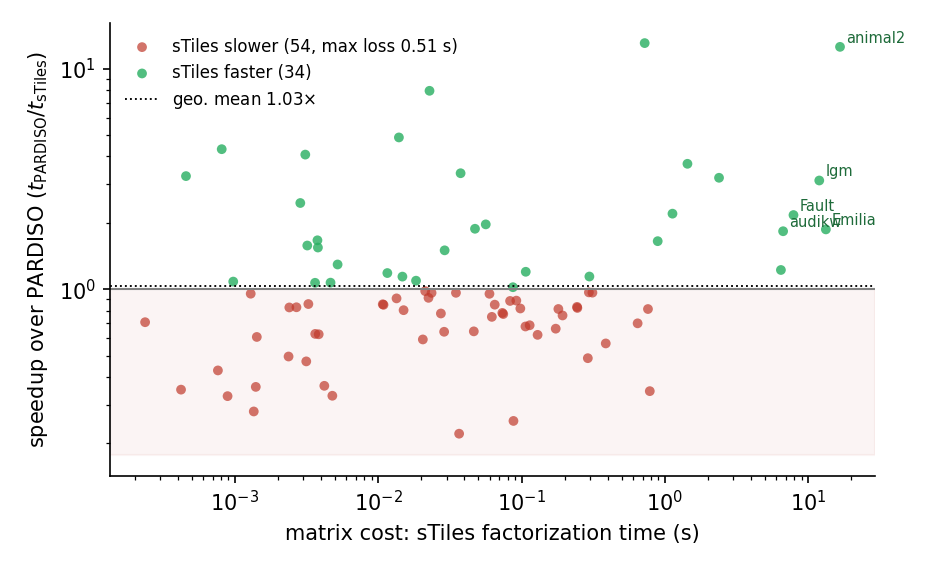
Per-matrix speedup of sTiles over PARDISO against matrix cost (both axes logarithmic; a value above the 1× line means sTiles is faster). sTiles is faster on 45 matrices and slower on 15, with a geometric-mean ratio of 1.50×. The two outcomes are asymmetric: every loss is on an inexpensive matrix, all 15 under 0.15 s and the largest margin 0.133 s, while the wins are on the expensive matrices and reach minutes.
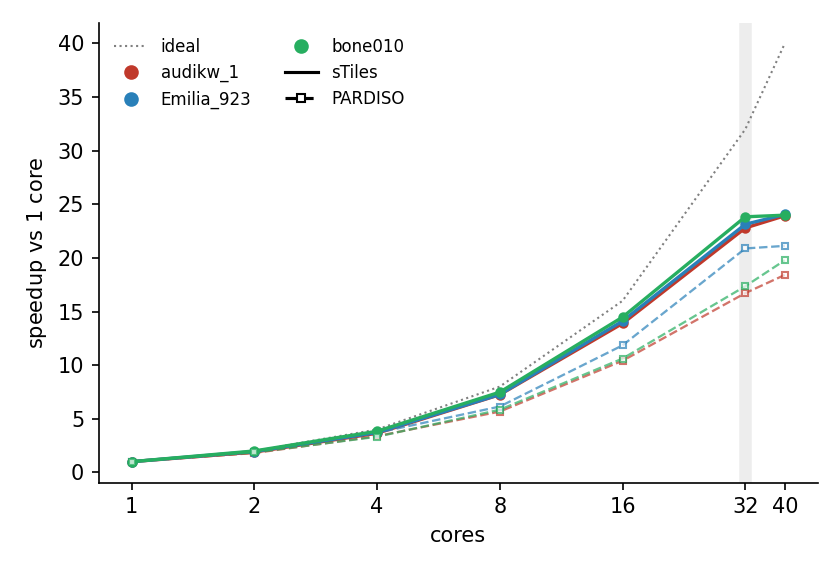
Parallel efficiency (speedup over one core divided by the core count; 1.0 is ideal) of a single factorization on three large finite-element matrices, sTiles (solid) against PARDISO (dashed). sTiles holds above 0.85 through 16 cores, where PARDISO has already fallen to 0.5–0.6; both drop sharply past 32 cores (shaded band), the socket's memory-bandwidth ceiling for sparse Cholesky.